linksite: www somainamithinga.yolasite.com / www borobathou.yolasite.com/www falangihouse.yolasite.com



A Bodo girl always tries to bring out the beauties of nature at her handloom. Her passions are spun in the weft and the wrap of dokhona. For a Bodo maiden weaving itself is a passion. She can sit at her handloom day after day till her dokhona is ready. She has nothing to complain against the cumbersome and the slow process of the traditional handloom. 'Tang-a -cultang' goes the striking of the hand shuttle with the frame of separator strips.
Dokhona, the traditional dress of the Bodo women is a thing of pride to all the Bodo people. This oblong sized garment measuring about 1 ½ x3 metres is woven by the Bodo girls themselves. Although it is difficult to say for certain about the source of the word 'dokhona', it may have its origin in or at least a link with the Buddhist word 'drubkha' by which the Tibetan/Bhutia women's dress is known. It is quite natural to glide from drubkha to dokhona & vice versa. The Bodo language shares some common words with the Tibetan language. For example, we can mention the word road called 'lam' in Tibetan and 'lama' in Bodo, and the numerical words 'se', nõi, tham, etc. have no difference. However, it is not only the Tibetan language with which the Bodo language has got its link many Bodo words found to have similarities in the languages of the Tibeto Burmese origin found in the North Eastern Region of India.
The skill of weaving comes naturally to a Bodo girl. In fact, it is the first criterion for recognising the girl in the society. Before selecting a bride the parents of a boy usually procure information about the skill of the would-be bride of weaving. Mere knowledge of making a cloth` wouldn't do. She must be able to weave varieties of embroideries, flowers, patterns, etc.
A sensitive ear from a distance wouldn't fail to catch the indicating note of regular strikes by a Bodo maiden's expert hands at the loom.
Like other Indo-Mongloid groups in India the Bodos have been jealously guarding the skill of thread spinning and weaving. Some scholars maintain that in the prehistoric period the Bodos first entered the North-Eastern India through the Patkai hills to do silk trade. It is noteworthy that the Bodos after their arrival in the plains of Assam, Bengal, Bihar and Nepal gave up their etinerant nature, including the silk trade and settled down in these places to become an agricultural community. They, however, couldn't give up weaving and thread making, because they couldn't afford to lose this skill at a time when cloth was scare. Anyway, when thread was found available in the market, they gave up spinning thread except for eri shawl. Eri shawl is made from the cocoon of caterpillars. It is famous as winter clothe. It is soft, handy and has got high quality of heat resistance. Its popularity is not confined amongst the Bodo people alone. People of other communities also use this clothe with great admiration. It is also used by old people as a status symbol or as a token of respect.
Bodo girls wear a shoulder scarf known as 'pasra' along with the dokhona. This complimentary pieceis put on as a protection or the chest from cold weather as well as an ornament. Man's aesthetic sense is the resultant development of his effort to meet the basic necessity of life. For this reason aesthetic sense differs from community to community. The Bodo girls adopted a dress, which became handy for them while living in plains. This sense of beauty of a Bodo maiden in her dokhona came later on.
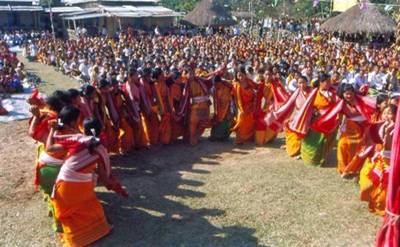
A Bodo girl's dress has a perfect harmony with the Bodo dances. Unlike the other tribal dances most of which are performed by forming a ring, a reminiscent of campfire in the hunting days, the Bodos have adopted a free style dance imitating nature. The dance of Bodo girls are the imitations of the movements of a butterfly or the movements of the nature. The splendour of the colourful dokhona and the graceful swings of pasra (scarf) lend a fascinating sight to the performance of a Bodo dance. The greatest compliment paid by an observer to the Bodo dance may bequoted from the national daily 'The Statesmen', January 29, 1957. The observer said
"………the charm that his simple folk cast on the sensitive spectators is difficult to describe. Surely, it was best expressed in the lovely dance of the maidens of the Bodo Tribe of Assam, a dance performed in secrecy of the night, that was probably never before witnessed by outsiders…". There are no complicated movements in the dance. The dance is like one of those simple yet mysterious decorations in the crown of nature, which have never fatigued the eyes of an observer.A most common feature in a typical Bodo homestead is the presence of weaving looms. In brief, weaving for the Bodos is a way of life. A loom is something that is abiquitous in every household and weaving is invariably a skill learnt by every female member of the family. The everyday garb worn by the Bodo-Kachcharis are chiefly characterised by the home-spun quality and rich vibrant colours. The male members sport gamochas woven at home which are wrapped around from the neck to the knee. Men also take an aronai around the neck and the head. These are essentially woven at home. The womenfolk wear a wrap called dokhona – a long piece of cloth worn around their chest, which falls to their ankles. Dokhnas are sometimes plain and sometimes ornamental. It is said that the womenfolk prepare the warping of the aronai and also weave the same in a single night. Aronai in various designs are generally used by men, while the female counterpart put on the aronai while performing the Kherai dance during different festivals. The aronai has become an ubiquitous cloth, forming an intrinsic part of the Bodo culture, portraying the ethnic approach of the Bodos. Typically, there are many classic designs or motifs which are woven on an ornamental dokhona, usually made of silk. By and large, Western clothing is yet to make its impact on the dress code of the Bodo-Kachari. Even the school uniforms of many Bodo medium schools are their traditional garb of dokhona and jumgra.
The people have retained strong links with their roots, tradition and customs, even in this day of the onslaught of Western culture into the very fabric of their lives. The craft of weaving, which conventionally employed traditional methods, is fast being replaced by more productive techniques. With its commercialisation, the handloom industry has opened up new avenues, giving employment opportunities to lakhs of Bodo weavers. Such essential infrastructural paraphernalia of the handloom business like the Handloom Training Institute, Handloom Production Centre, Weavers Extension Service Unit, common facility centre, yarn bank and computer aided design centres, which have developed in the BTAD area, have definitely geared up the economy of the people


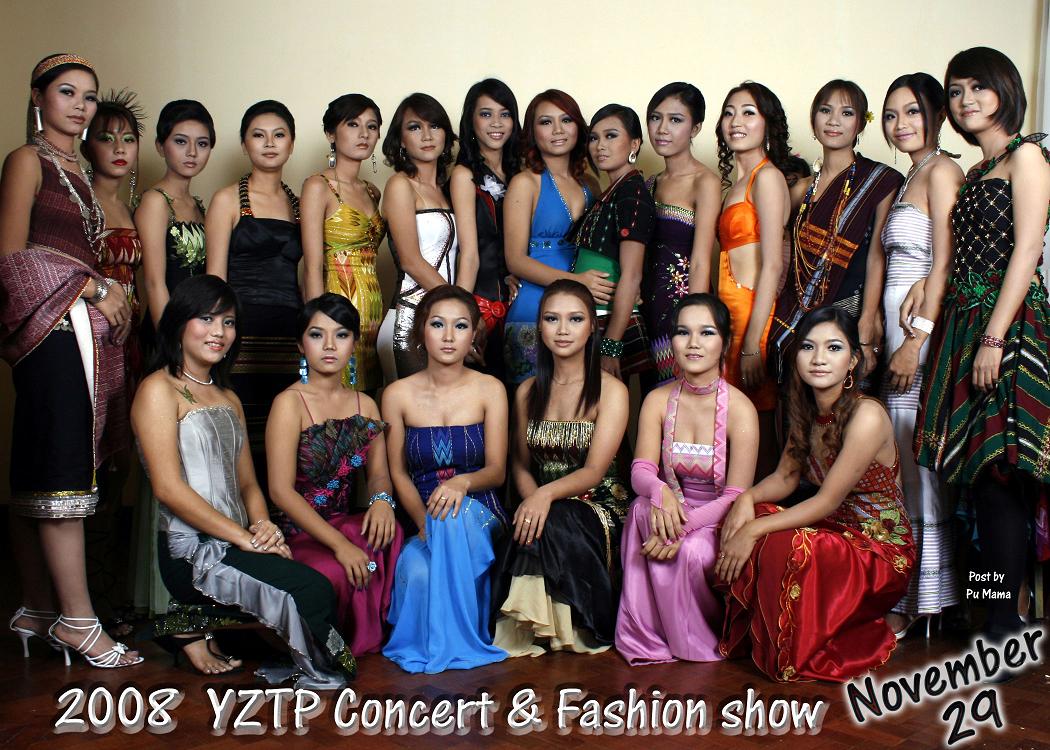

June 10, 2010 (Sampurn Wire): Former supermodel and renowned fashion designer Bibi Russell has associated with the traditional Bodo women of Assam to create a new line of lifestyle products which will be a mixture of ethnic Bodo culture and high end fashion.
Bibi Russell will train Bodo women for “Weaving Destinations’ to work with modern design techniques and develop their range of skills that will help them market their products as a premium label. The Bodo women working for “Weaving Destinations’ include HIV patients, survivors of human trafficking and women migrant returnees who are highly vulnerable to re-trafficking and are social outcasts.
Russell, a UNESCO designer for development, has recently visited the Bodo heartland and met the local weavers. She was all excited over the beautiful designs, especially for the endi and eri silk. She also praised the vibrant colours and shades used in the different designs woven by local women.
The designer had promised to work with local Bodo artists and promote their product on the international stage. She said that the Bodo weavers produce a range of hand-woven products that preserve traditional Bodo Motif and weaving techniques for both individual and industrial purpose.
The “Weaving Destination’ is a part of the “Women and Wealth Project’, a provincial social endeavor by the United Nations development program (UNDP) and the Population and Community Development Association (PDA) of Thailand, aspired at the socio-economic development of women living with HIV.
Russell recently featured her trademark “Gamcha’ collections and “Jamdani’ saris at Kolkata Fashion Week, 2010. Russell works in Bangladesh to preserve and promote the hand-woven textile industry there
Fashion Fever
Fashion is no longer a glamour hobby, it has rather become a serious career option for the North-Eastern youths.
Sandeep Banerjee
The first North East Fashion Week was held in Guwahati from 25th to 27th of April, 2008. The same was organized by North East Institute of Fashion Technology (NEIFT) which has today become the premier institute in the region for grooming aspiring students of make a cut in the fashion world. The three-day event was sponsored and presented by AIRTEL and supported by Silk Mark, Ministry of Textiles, Government of India and the Bodoland Territorial Council (BTC). Vikram Rai Medhi, a big name in the fashion scene of the North-East and the CEO of NEIFT was himself the event director of the fashion week.
The event gave a unique platform to big names in Fashion designing as well as young budding designers from NEIFT to showcase huge variety of clothes design. “This is the first year. The child has just taken birth. The motive is to get industry status for fashion designing. Different designers have come together in one platform. There have been healthy exchanges of views and ideas in the three-day event that will give a big boost to the quality of creations coming out from the region. The other big motive to organize this fashion week is to market the fashion products coming out of the region. Silk received a big thrust in this fashion week. The event was not only supported by Silk Mark but they also participated in the event in a big way. The exhibition features quality silk products from Silk Mark as also products from our own handloom industry. We are striving to also bring up the beautiful products of our handloom industry…give them proper exposure and market them. The first NE fashion week was a small step keeping all these motives in mind. It has been a humble beginning. With time and every passing year, I am sure this event will grow in stature and magnitude,” said Vikram Rai Medhi.
The fashion week and the accompanied exhibition at the venue was inaugurated by K. S. Menon, CEO of Silk Mark organization under Ministry of Textiles, Government of India, along with B. Deb, Director of Handloom & Textiles, BTC and J. L. Chowdhury, Deputy CEO, KVIC.
The first day saw big names like Meghna Rai Medhi, noted designer from this region and Dipankar Kashyap display their creations. On the second day there was a seminar on ‘Silk of North-East and the role of Silk Mark in its growth” that again saw the participation of K. S. Menon, B. Deb, J. L. Chowdhury along with D. K. Sharma, the secretary of North East Chamber of Commerce & Industry (NECCI) and some noted designers like Kunal Kaushik of Assam. Kunal Kaushik also returned in the evening to steal the thunder by his wonderful show named ‘Woven Mystique’ in which he blended the traditional costumes of the North-East with modern day styles to create a fascinating dress fusion. Other talented designers like Anusmita Borgohain and Julie Sarmah (both from Assam) and Sangboihi from Mizoram also featured in the evening highlighting a plethora of fabrics cut in a wide range of innovative eye catching designs. Sangboihi in particular received much accolades for her presentation named Diversion.
The last day saw 21 students from NEIFT drawn from different North-Eastern states (there were eight from Assam, six from Nagaland, four from Mizoram, one from Arunachal and two from Manipur) presenting their creations with a distinct emphasis on the handloom of the North-East. The final show of the same evening and the first NE fashion week was presented by Meghna Rai Medhi who is the first designer from the North-East to be featured in Femina and have dressed the likes of Aishwarya Rai, Celina Jaitely, Koena Mitra, Diana Hayden, Bipasha Basu and other top socialites of the country. Meghna presented her spring summer collection having an Indo-Western look in peach pink and vibrant shades of orange. There was also a separate collection of beautiful Asomiya Mekhala Chadors and sarees. Meghna Rai Medhi was also the fashion choreographer of the entire NE fashion week.
During the fashion week Bodo handloom got impetus. Leading North-Eastener designers like Anju Borgohain, Megna Rai Medhi, Ashish Chanda, Hemanta Adhikari and Dipankar Kashyap displayed work in Bodo handloom and silk.
“Local fabrics including silk will help future designers have an edge over others. Fashion has a competitive market and they need to excel. Hand woven fabrics from the North-East are gaining in popularity every where. We asked our students who got an opportunity the showcase their designs at the NE Fashion Week to make optimum use of the hand woven fabrics of the region. But at the same time they were also free to experiment with other fabrics and unleash their creativity.’’ , said Vikram Rai Medhi.
Apart from three models from Russia, Miss India Pacific Shonal Rawat and Miss Mauritius, Viveka Babaji walked the ramp at the NE Fashion Week.
On the second day in the seminar on Silk, the discussions led to suggestions on how the future designers can put the idea of importance of silk production and use it at the grassroot level to stop duplicates, which is a threat to North-Eastern sericulture Industry.
Kunal Kaushik speaks
“I am trying a fusion of all North-Eastern fabrics drawn from Bodo, Naga, Mizo, Rabha and Manipur areas. The hand-woven and ethnic fabric of our region has a unique identity and has tremendous potential but due to lack of support our traditional fabrics are dying a slow death. Modernity and western outfits are fine but we must not lose our fantastic traditional fabrics. So the need of the hour is to revive traditional fabrics by giving it a modern touch and making it attractive. The marketing part is also very much important. Here is where an event like the NE fashion week becomes so important. Some people tend to look down at these events as mere exhibitions. But actually here is where business happens. Weavers of the region will perish until they don’t get market…shows like these will provide right market to our fabrics,” he said.
“Attitude towards fashion have changed”: Meghna
“The concept of a North East Fashion Week was always there in my and Vikram’s mind. Only that it took some time to give shape to an event of this magnitude. But with the first edition having been successfully organised this year, it will now surely become an annual event. For long we have been just talking of giving exposure to the designers and the models of this region.....we felt that the time has come now to go beyond mere talking by doing something concrete in this area. The North East Fashion Week was borne out of this thinking. Under one roof people could find out the worth of the leading as well as the upcoming designers of the region. In fact Vikram and me are even thinking ahead.....of setting up a mall where all such designers will be provided racks who cannot afford to have a store of their own at the present moment....however, this project will take some time to materialise.’’
“When we started it was very difficult to procure materials. But now it has become lot easier for the present generation of designers with far greater reach and easier access. Also the mindset of the people towards fashion has changed with the coming of all big brands and designer stuff at their very doorstep. Big names like Ritu Kumar and Satya Paul have come to Guwahati. There are now Pantaloons and Levis showrooms. Siiting here people can purchase Rocky S creations. This atmosphere is very conducive to the present designers and the upcoming ones to also market their products.’’
“The select batch of students that we have in NEIFT are a very talented bunch.They only need proper exposure of their work. So we encourage them to hold as many shows as possible to reach out to the public. We want them to unleash their creativity and judge for themselves how the audience reacts to their designs. The main thing is the art of presentation. If if you have designed just a single dress but know the art to present it properly , then the job might get done. However , we warn our students not to go overboard from the very beginning in trying to open themselves up but rather expose their creativity in a slow and steady manner. Most of the times we do not even charge the tailoring cost for the dresses designed by our students...however, there are some who are doing it totally on their own.’’
“I will take the NE models to be of extremely good quality today and they are very hard working . The modelling scene has also undergone a sea change from when we started. During our earlier days we use to literally stop a tall and good looking girl in the middle of the road and coerce her to model for us. But the NE now boasts of a huge pool of wonderful models at par with the very best in the country.We are now even getting tall and very tall wonderful models from within the NE.......although herein I must say that I do not give too much attention to the height...it is the total persona , charm and presentation that matters In the NE Fashion Week all the male models were from Guwahati while the girls were drawn from all over the North-East. They matched steps and elegance with the hyped Russian models as well as big names like Viveka Babaji and Shonal Rawat.’’
“Style and Fashion is something that comes from within. The conception and attitude towards style has also undergone a sea change. Today even parents come to us and say that their girls can be easily clothed in a kind of fashionable dress which till some times back could have been outrightly labelled as vulgar. But when I say this, I feel that all designers as well as models must know and understand the line that separates the fashionable from the obscene.’’
“I am satisfied with my journey so far and what I have achived but there is always the urge and strive to do and achieve more. My store ‘Meghnas’ is doing very well and I have a very good clientele... ladies who have total faith in me and how I cloth them. I want every woman from this region to take at least one dress from me (laughs). I have just started my male line....it started with a programme in a local channel whose costume I am doing.’’
“Our tie up with BTC in the North East Fashion Week was spontaneous. I have been working with Bodo fabric for quite some time now. I have some very fashion conscious Bodo women as my client. The Bodo fabric is very fascinating and I have designed previously outfits by giving a modern outlook to their traditional fabric. The Bodo weavers are also experts and they dominate the weaving scene of Assam. So Viram and I thought to give a more concrete shape to the relationshipi by involving the BTC in the Fashion Week , a proposal to which they readily agreed. We bought all the materials from Kokrajhar for the Bodo attires.’’




Trending: The North East
Think football and what comes to mind is Baichung Bhutia. Instantly and naturally. And what comes to mind when you hear Mary Kom’s name? Boxing, of course. Now, think of where both these sports stars come from. Not many would know that Bhutia and Kom come from two different states in the North East of India. The North East comprises eight states: Assam, Arunachal Pradesh, Meghalaya, Mizoram, Manipur, Nagaland, Tripura and Sikkim. And often people from this region are mistaken for Chinese! But for those who know them, people from that part of India are a lively bunch who love the good life like everyone else. And if you are GK Pillai, the former Union home secretary, you might like to add that they are “a talented lot.” (Make that “very very talented!”)
 Pillai should know. He has had a long stint as a government official in charge of the region. “There is immense potential in the people and the land. I have been impressed by their talent and creativity. Today, their talents are partly recognised, but they need to be fully recognised,” says Pillai.
To writer and filmmaker Jahnu Barua this recognition of North East talent is just “the beginning of a long journey.” Nonetheless, he says: “The driving force of these people is immense since they know that they have come from so far away to make something out of themselves. So you cannot ignore them anymore.”
Indeed, you can’t. Whether it’s sports, music or fashion, we’re seeing a lot of North Easterners out there. Their food too is preparing to compete with other cuisine in the market. And their unexplored and virgin land is drawing tourists like never before

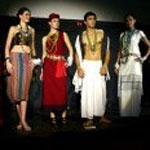


Designing Silk Dreams
She whistles a typical tune as she winds up for the day. Dressed in a colourful dokhona (traditional attire worn by Bodo women), 25-year-old Sumitra Narzary flashes a proud smile as she displays her new pair of gold earrings and a set of cosmetics which she has bought with her earnings. It was otherwise a dreary existence for the unmarried girl from Rajadhab village in Kokrajhar district in Assam when she was sitting at her home tending to the household chores and occasionally weaving a dokhona in her grandmother’s loom.
Her life transformed when she learnt about Roje Eshanshali (beloved weaving), a cooperative society which trains women in the techniques of weaving and churning out contemporary designs out of traditional material. She is now equipped with improvised training by experts from the National Institute of Design, (NID) Ahmedabad who had visited the society.
“It’s a wonderful feeling that I now have my own savings and can buy things for myself. I can also contribute to the family expenditure when necessary,” smiles Sumitra. She enjoys the flexible work hours where they have freedom to go home and even go fishing once in a while.
.
The cooperative society organises training programmes on employment generation activities like spinning, reeling, weaving of silk and cotton fabrics, dyeing. Formed in 1996, Roje Eshanshali cooperative society was the brainchild of a few women from the Bongaigaon Thermal Power Station in Salakati in Kokrajhar.
“Almost every Bodo woman knows how to weave. We wanted to economically empower the women of the area by harnessing their inherent skills,” adds Narzary. The formation of the society was a succour to the women in the once conflict-torn area which was ravaged by militancy. In the backdrop of bloodshed and conflict, a mini weaving revolution was being initiated by the nimble fingers of the Bodo women. Narzary, who cuts a motherly figure with many of these young girls, has been working to hone their skills and thereby economically empowering them. The society’s work has emerged from the remote hamlets of Assam to reach the Surajkund Mela in Haryana and the Dilli Haat in Delhi.
The society now churns out a whole range of products ranging from bed sheets, shawls, dress materials, mobile covers, mufflers, stoles, scarves, handbags, file-holders, photo-frames and home furnishings among others.
From a humble prelude of only five members and four looms, the society now has over 1,000 women beneficiaries in Kokrajhar, Bongaigaon and Chirang district. There are also several home weavers in remote and inaccessible areas. “We have indirect beneficiaries all over Assam as we procure thread and other materials from them,” adds Narzary. By overcoming the initial hitches, apart from being a hit in the local market, Roje Eshanshali now even supplies its products to Maneka Gandhi’s “Ahimsa Peace Silk Project” and exporters. “Our Eri and Muga silk mixed material is exported to the UK,” she informs.
The society had formed 25 self-help groups and five community centres for Eri spinning and weaving under the Swarnajayanti Gram Swarojgar Yojna. It has also implemented the United Nations Development Programme for development of Muga and Eri silk industries. In tune with the changing market trends, Roje Eshanshali even takes advice from fashion designers in acquainting the weavers with the contemporary fashion trends.
The society has ambitious plans. “We want to make a home for these destitute women, especially for the victims of insurgency,” says Narzary. In the Bodo heartland, Raje Eshanshali is weaving dreams, literally.


